What belongs on Black Friday bilingual price cards for 2026?
Build a bilingual Black Friday price card for one item, with paired names, a clear sale price and checks for currency, size and product shape.
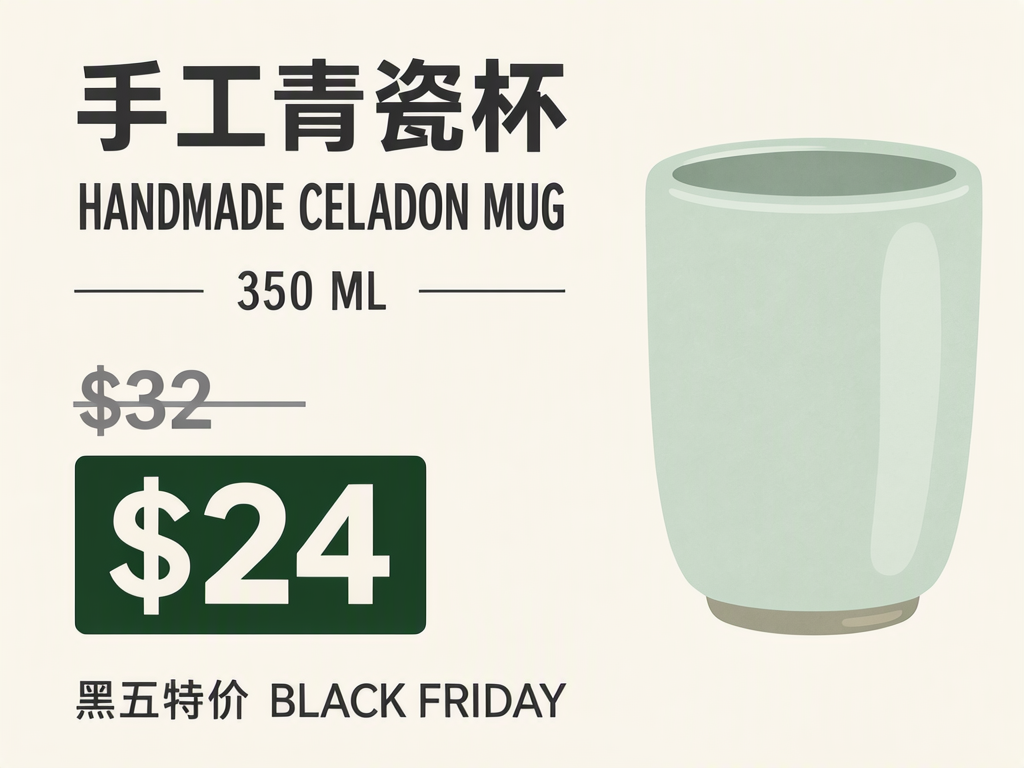
Black Friday bilingual price cards for 2026 should identify one item in both languages, state its size and distinguish the old price from the sale price. Black Friday is Friday, November 27. These celadon-cup examples use Chinese and English names with a single dollar currency, so the reader can check the product and payable amount without navigating a miniature catalogue.
TL;DR
- Pair both names with the same product and size.
- Keep the old price visually subordinate to the sale price.
- Confirm the currency before copying a dollar symbol.
- Check the depicted product as well as every character on the card.
What belongs on a price card for one bilingual item?
Put the two names together, then give the size and price their own space. The sample reads “手工青瓷杯,” “HANDMADE CELADON MUG,” “350 ML,” a struck-through $32 and a boxed $24. The Chinese name means “handmade celadon cup”; “黑五特价” means “Black Friday special price.”
We used US dollars, but the artwork prints only $. If the card will circulate across markets, use an explicit currency code and keep both prices in that currency.
The shop, the cup and both prices are made up for these examples.

Make one like this Open this image on MOSS Image
Made in the Layout Builder with these boxes:
| Box text / object | Job | Approximate position |
|---|---|---|
| 手工青瓷杯 | Chinese name | Upper left |
| HANDMADE CELADON MUG | English name | Below Chinese |
| 350 ML | Capacity | Middle left |
| $32 | Previous price | Middle left |
| $24 | Sale price | Lower left |
| 黑五特价 BLACK FRIDAY | Sale label | Bottom left |
| (illustration) | Cup illustration | Right |
Our first try got both names, the size, crossed-out $32 and boxed $24 right. One currency was used throughout. The sale figure has its own green box, which separates it from the description instead of making it compete with the long English name.
How should the old and new prices relate?
Make the sale price the amount the shopper can identify without interpreting a paragraph. Keep the old price nearby and visibly crossed out if that is the comparison you intend to show. Confirm the underlying prices with the shop before generating.
| Element | Sample treatment | Your check |
|---|---|---|
| Chinese and English names | Stacked together | Both identify the same item |
| Size | 350 ML below the names | Matches the item being sold |
| Previous price | $32 with a strike-through | The line is visible and the number is approved |
| Sale price | $24 in a green box | Correct amount and currency |
If you need a wider promotion with exclusions, use the separate structure in the Black Friday offer-terms examples. This card's task is narrower: one item, one size and one payable price.
What does the shelf scene add to the comparison?
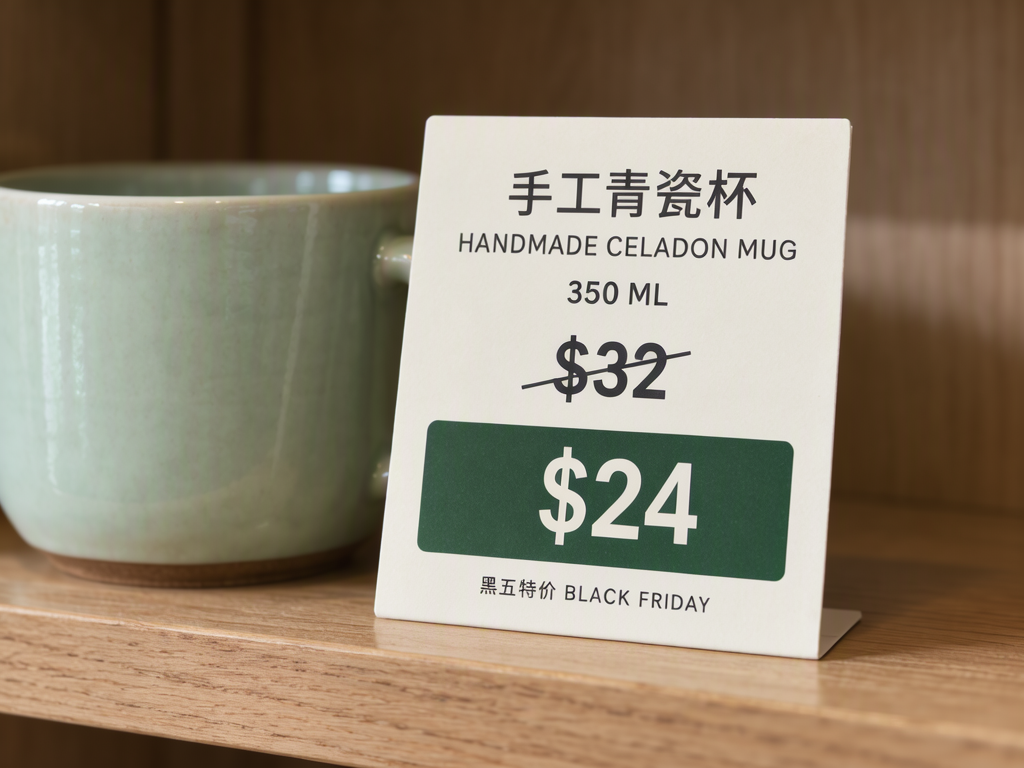
It places the same copy beside a cup in a generated shop setting. Use it to inspect how the name and price compete with the product image, while keeping the flat card as the simpler reference for the text arrangement.
Make one like this Open this image on MOSS Image
Made in prompt mode with this exact prompt:
Photograph of a small printed price card standing on a wooden shelf next to a pale celadon green ceramic mug, soft daylight, shallow depth of field, card in sharp focus. Warm white card, charcoal type, the sale price in a deep green box. Text, render exactly and add nothing else: Chinese name '手工青瓷杯'; English name 'HANDMADE CELADON MUG'; line '350 ML'; struck-through price '$32'; boxed price '$24'; small line '黑五特价 BLACK FRIDAY'.
All six required lines came out right on our first try. The shelf image shows a mug with a handle, while the layout image shows a handleless cup. We asked for the product names without a separate shape instruction. For a shop card, compare the illustration with the actual item and specify its shape in the next prompt if needed.
Check the size line against the product listing as well as checking its spelling. Keep the name, capacity and price together in your working copy so a later change to the product updates the whole card.
What remains uncertain before printing?
Both versions got the copy right on our first tries, but their cup shapes differ. Check bilingual names, units and currency signs character by character, then compare the illustrated product with the item on the shelf.
Print a proof beside the item it will identify. Cover the old price briefly and read the sale amount, then uncover it and check that the strike-through is unmistakable. Ask someone to point to the size without reading the whole card. If the English name crowds that line, enlarge the text area or reduce the illustration before shortening the actual product name. Keep words that distinguish this item from a neighbouring one.
How can you make a bilingual card for one product?
- Open a 4:3 landscape canvas, the ratio used for both cup examples. In the Layout Builder, group the Chinese and English product names above a separate size line.
- Draw distinct old-price and sale-price areas. Enter both amounts in the same currency, request a strike-through for the old price and give the sale price its own coloured box.
- For a shelf scene, use the AI poster generator at 4:3 and quote all six lines. Describe the actual product shape separately, following the exact-text guide.
- Compare the sale amount and currency first, then the size and paired names. Place a print proof beside the product and check that the illustration identifies the item customers will receive.
MOSS Image Studio is an independent hosted studio for the open MOSS-Image model. Not affiliated with OpenMOSS.
FAQ
Do two languages require two currencies?
No. The sample uses a single currency for both prices. Choose the transaction currency for your shop, and identify it explicitly when the audience could read the symbol differently.
Should I translate “mug” as 马克杯?
Confirm the product first. The sample Chinese says 青瓷杯. Use the name your shop has approved for the actual item, especially if the handle or form matters to customers.
Can I use the shelf scene as a real product photograph?
It is a generated scene, not evidence of your stock. Inspect the shape against the real item and avoid presenting the illustration as a photograph you took of it.
Sources
- 2026 occasion dates and weekdays — Checked on 2026-11-03.
Try it with your own words
Open the Studio, write a brief or lay out boxes on the canvas, and generate with MOSS-Image.