Course Enrolment Poster: Audience, Outcome and Fee
Write a course enrolment poster that explains who it suits, what students will make, prerequisites, the fee and exactly which materials it includes.
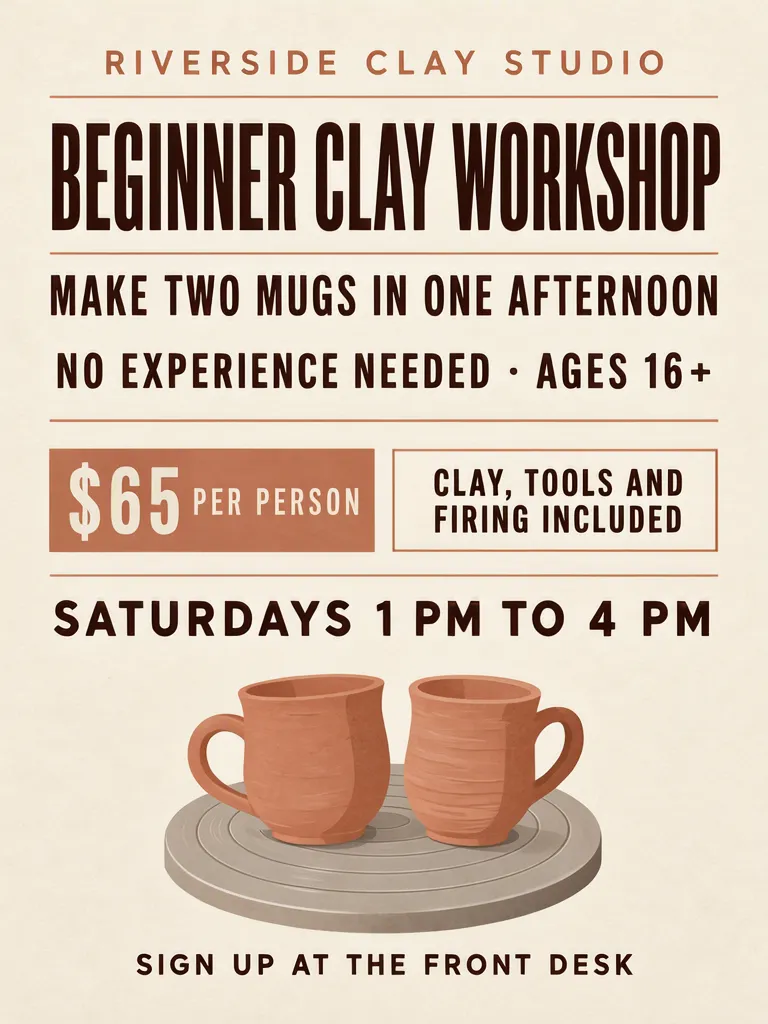
A course poster helps someone decide whether to enrol when it states who the class suits, what they will make, what they need beforehand, the fee and what that fee covers. Our pottery example is for beginners aged 16 and up, promises two mugs in one afternoon, and lists a $65 fee that includes clay, tools and firing. Treat those as sample details and replace them with the real class terms.
TL;DR
- Name the intended audience and any age or experience prerequisite.
- Describe a concrete class outcome in plain language.
- Put the fee beside a clear statement of what it includes.
- Check every line, especially the amount and included materials.
What should a course enrolment poster explain?
A prospective student needs to know whether the course fits, what they will leave with, what participation requires and what they will pay. Our fictional Riverside Clay Studio example says “MAKE TWO MUGS IN ONE AFTERNOON,” “NO EXPERIENCE NEEDED · AGES 16+,” and “$65 PER PERSON.” A neighboring box states “CLAY, TOOLS AND FIRING INCLUDED.” The sample also lists Saturday hours and says to sign up at the front desk. The studio, schedule and fee are made up for this example.
Make one like this Open this image on MOSS Image
Made in the Layout Builder with these boxes:
| Box text or object | Purpose | Approximate position |
|---|---|---|
| RIVERSIDE CLAY STUDIO | Studio name | Top |
| BEGINNER CLAY WORKSHOP | Course title | Upper area |
| MAKE TWO MUGS IN ONE AFTERNOON | Outcome | Middle |
| NO EXPERIENCE NEEDED · AGES 16+ | Audience and prerequisite | Middle |
| $65 PER PERSON | Fee | Solid terracotta box |
| CLAY, TOOLS AND FIRING INCLUDED | What the fee covers | Outlined box beside fee |
| SATURDAYS 1 PM TO 4 PM | Schedule | Lower middle |
| Two mugs on a pottery wheel | Illustration | Lower area |
| SIGN UP AT THE FRONT DESK | Enrolment step | Bottom |
The layout keeps the fee and the included materials in two adjacent but distinct boxes. That separation lets a reader connect the cost with what it pays for without turning the included list into part of the price. It also assigns independent space to the outcome, audience, schedule and sign-up instruction, which are the details a person often needs before asking a question.
How can you make an eight-line prompt easier to check?
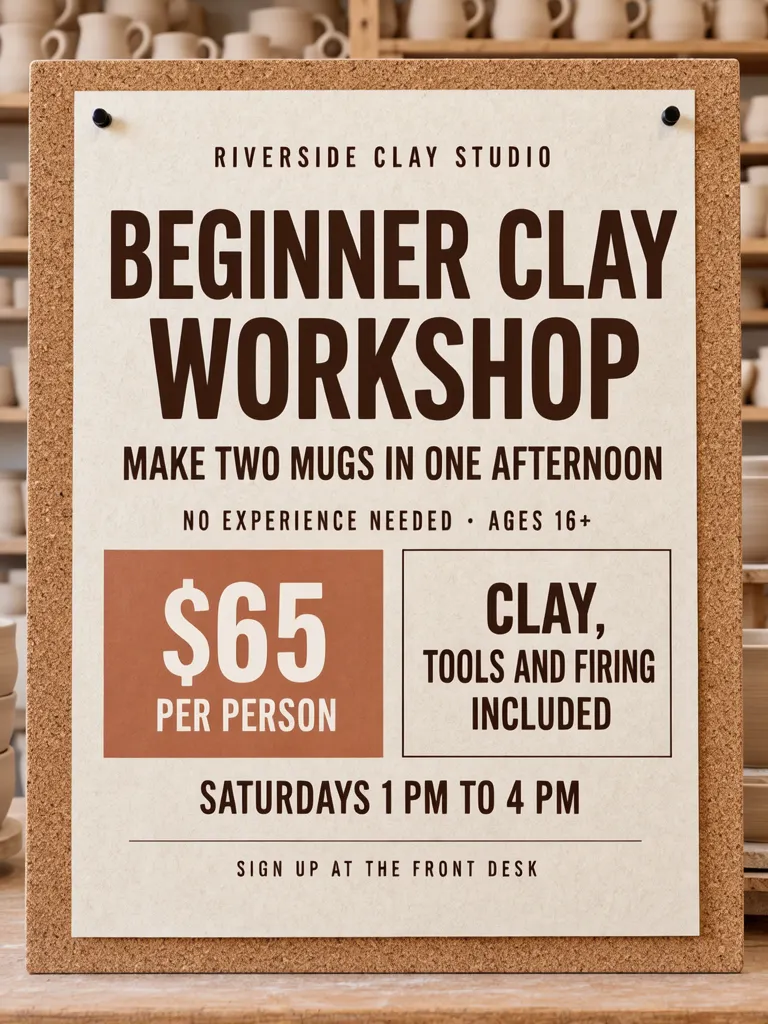
Use short positional words to introduce the copy, and describe boxes by their colour or appearance rather than their meaning. The photo prompt produced a difficult result on try 2: “studio” and “fee” appeared on the poster, the N disappeared from BEGINNER, and “FIRING INCLUDED” became “FIRINGULE INCLUDED.” The description “a box saying what it covers” also became an extra heading, “WHAT IT.” We changed the line introductions to positional labels and described the two boxes by colour. Try 3, the shared photo, rendered all eight lines correctly without extra words. The included box broke its text into an unexpectedly large first line and smaller following lines.
Make one like this Open this image on MOSS Image
Made in prompt mode with this exact prompt:
Photograph of a printed workshop poster pinned to a cork board in a pottery studio, shelves of unglazed mugs softly blurred behind, poster flat and in sharp focus. Oatmeal paper, dark brown type, one solid terracotta box and one outlined box side by side. The cork board holds this one poster only. The printed piece holds only the quoted text, and nothing else in view carries any writing: no other signs, labels, stickers or notes. Text, render exactly and add nothing else: top line 'RIVERSIDE CLAY STUDIO'; headline 'BEGINNER CLAY WORKSHOP'; line 'MAKE TWO MUGS IN ONE AFTERNOON'; line 'NO EXPERIENCE NEEDED · AGES 16+'; line in a terracotta box '$65 PER PERSON'; line in an outlined box 'CLAY, TOOLS AND FIRING INCLUDED'; line 'SATURDAYS 1 PM TO 4 PM'; footer 'SIGN UP AT THE FRONT DESK'.
The first photo request failed at the image service and its credit was restored; it did not produce a poster. Try 2 is the worked example of why labels and long prompts need careful checking. Try 3 is the shared image. Read the full fee line and included list rather than checking only whether the largest words look right.
How should you explain a course fee?
Write the amount and billing basis together, then state what the payment covers. “$65 PER PERSON” clarifies that the sample fee is per attendee; “CLAY, TOOLS AND FIRING INCLUDED” describes its scope. If materials, shipping, taxes or facility costs are separate for your real class, say so in plain words. Avoid a vague phrase such as “all included” unless the organizer can stand behind it.
| Poster detail | Sample wording | What the reader learns |
|---|---|---|
| Audience | NO EXPERIENCE NEEDED · AGES 16+ | Whether prior skill or an age threshold applies |
| Outcome | MAKE TWO MUGS IN ONE AFTERNOON | What the session is intended to produce |
| Fee | $65 PER PERSON | Amount and charging basis |
| Included | CLAY, TOOLS AND FIRING INCLUDED | Which listed costs are covered |
| Schedule | SATURDAYS 1 PM TO 4 PM | When the class meets |
A course title alone is not an outcome. “Beginner Clay Workshop” names the activity; “Make two mugs in one afternoon” gives a concrete expectation. Keep the claim aligned with what the instructor and session can actually deliver. If the work may need to be collected later after firing, explain that in the final poster rather than implying a finished object is ready at the end of the afternoon.
What should you check before sharing the poster?
Try 2 printed labels from the prompt and changed several words, including BEGINNER and FIRING INCLUDED; try 3 fixed the text but gave the included box uneven line sizing. Before publishing, compare the class title, age requirement, fee, materials, schedule and enrolment method with the organizer’s confirmed details. Check spelling at full size and at phone size. Make sure the price basis is unmistakable and that every item described as included really is covered by the fee.
Do not read a stronger promise into the poster than the class supports. A stated outcome describes the planned activity, not a guaranteed result for every participant. The sample has a front-desk sign-up route; use the real organizer’s current registration method and capacity instead of assuming that a poster will increase enrolments.
How can you make a course poster that answers enrolment questions?
- Start with a 3:4 portrait canvas. Draft the audience, outcome, prerequisite, fee, included items, schedule and sign-up method before choosing decorative copy.
- In the Layout Builder, assign a distinct box to each information group. Keep the fee and included items adjacent but separate, as in the sample.
- For a workshop photo, use the AI poster generator. Introduce each quoted line with positional wording such as “top line,” “line” or “footer.” Describe boxes by colour and outline instead of phrases like “box that explains what is included.”
- Compare all eight required lines with the class information. Inspect the fee basis, age limit and included list first, then check the schedule and sign-up instruction. The exact-text guide explains prompt wording for text-led images.
MOSS Image Studio is an independent hosted studio for the open MOSS-Image model. Not affiliated with OpenMOSS.
FAQ
What information should a course poster include?
Audience, course outcome, prerequisites, fee and its basis, what the fee covers, schedule and a way to enrol.
Should a course poster say what materials are included?
Yes. Listing included materials helps readers understand what the fee covers. Identify separately charged items clearly.
How do I describe a class for beginners?
State the experience level directly, such as “No experience needed,” and include any age or equipment requirements.
Try it with your own words
Open the Studio, write a brief or lay out boxes on the canvas, and generate with MOSS-Image.