Book Club Discussion Posters: Long Titles and Event Details
See how a long invented book title breaks across two poster styles, then organize the date, venue and invitation without borrowing cover art.
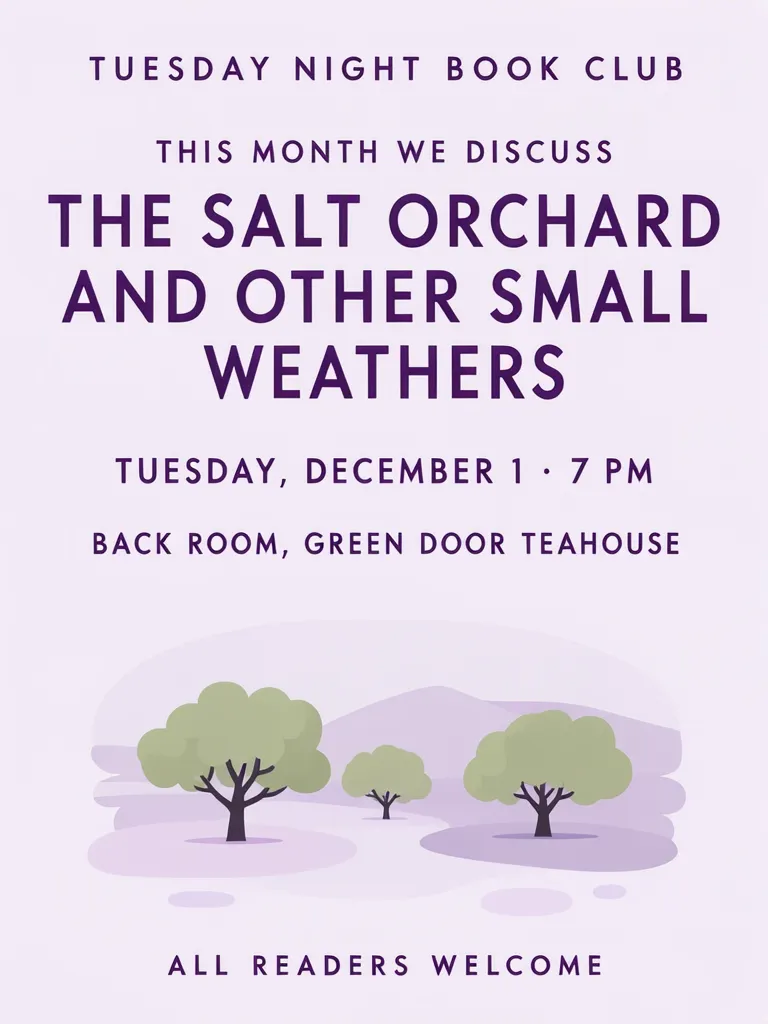
A book-club discussion poster should make the discussion title, date, time and venue easy to find, especially when the title is long. We used the invented title “The Salt Orchard and Other Small Weathers” so the examples need no real book cover art. The fictional club, venue and meeting details are made up. If you are promoting a real book, use original typography or artwork you have permission to use rather than copying its publisher’s cover.
TL;DR
- Put the discussion title ahead of supporting event details.
- Decide where a long title may break, then inspect its actual line breaks.
- Keep date, time, venue and invitation separate from the title.
- For a real book, do not copy the publisher’s cover artwork.
What should a book-club discussion poster include?
A useful poster identifies the club, the book or discussion topic, when the group meets, where it meets and who may attend. Our example uses “TUESDAY NIGHT BOOK CLUB,” “THIS MONTH WE DISCUSS,” the long invented title “THE SALT ORCHARD AND OTHER SMALL WEATHERS,” “TUESDAY, DECEMBER 1 · 7 PM,” “BACK ROOM, GREEN DOOR TEAHOUSE,” and “ALL READERS WELCOME.” The book, author and venue are fictional. No real book cover is shown.
Make one like this Open this image on MOSS Image
Made in the Layout Builder with these boxes:
| Box text / object | Purpose | Approximate position |
|---|---|---|
| TUESDAY NIGHT BOOK CLUB | Club name | Top |
| THIS MONTH WE DISCUSS | Introductory label | Below club name |
| THE SALT ORCHARD AND OTHER SMALL WEATHERS | Long discussion title | Large central block, three lines |
| TUESDAY, DECEMBER 1 · 7 PM | Date and time | Below title |
| BACK ROOM, GREEN DOOR TEAHOUSE | Venue | Lower section |
| Orchard illustration under a pale sky | Visual theme | Middle to lower area |
| ALL READERS WELCOME | Invitation | Bottom |
All six required lines were correct on the first try. The seven-word title breaks naturally over three lines: “THE SALT ORCHARD / AND OTHER SMALL / WEATHERS.” The line breaks give the book title enough space to dominate without turning the event time into a footnote. For your own design, write the title exactly as it appears on the book, then consider a few sensible break points before generating.
The title is invented, so the images use an abstract orchard rather than a real cover. For an actual book, get permission to reproduce the publisher’s artwork or use an original visual that does not copy its composition, lettering or illustration. The poster can identify the book by title.
How did the long title break in the photo version?
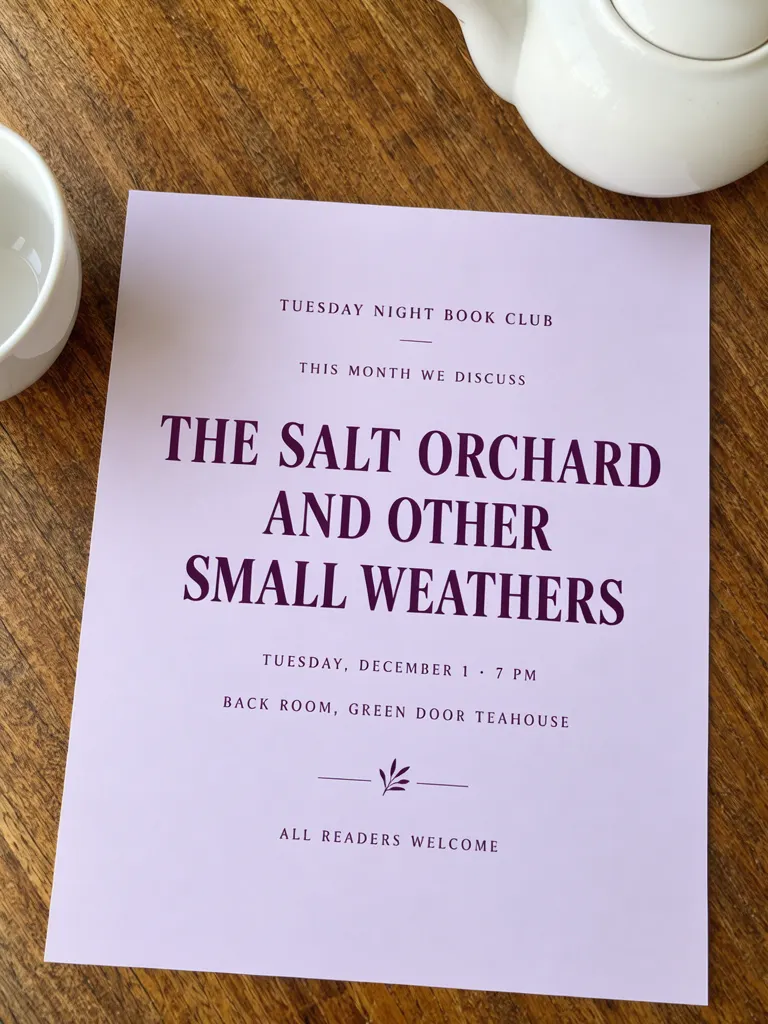
The accepted photo flyer uses a different three-line rhythm: “THE SALT ORCHARD / AND OTHER / SMALL WEATHERS.” The words remain in order, but the second and third lines break differently from the layout version. That change affects the shape of the title block, so check whether the line endings read naturally and whether any short word has been stranded.
Make one like this Open this image on MOSS Image
Made in prompt mode with this exact prompt:
Overhead photograph of a printed book club flyer lying on a wooden table beside a plain white teapot and one cup, soft daylight, flyer flat and in sharp focus. Pale lavender paper, plum serif type, the long title the largest text. No books or other papers on the table. The printed piece holds only the quoted text, and nothing else in view carries any writing: no other signs, labels, stickers or notes. Text, render exactly and add nothing else: top line 'TUESDAY NIGHT BOOK CLUB'; small line 'THIS MONTH WE DISCUSS'; headline 'THE SALT ORCHARD AND OTHER SMALL WEATHERS'; line 'TUESDAY, DECEMBER 1 · 7 PM'; line 'BACK ROOM, GREEN DOOR TEAHOUSE'; footer 'ALL READERS WELCOME'.
The first photo try printed the word “club” before the club name. The accepted share is try 2; its six required lines are correct, and the title breaks as “THE SALT ORCHARD / AND OTHER / SMALL WEATHERS.” The teapot setting places the flyer in a reading-space mood without showing a book or borrowed cover. Inspect both the text and the surrounding objects: the image prompt asks for a plain table setting so nearby props do not compete with the poster or acquire accidental writing.
| Version | Title line breaks | What to inspect |
|---|---|---|
| Layout Builder | THE SALT ORCHARD / AND OTHER SMALL / WEATHERS | Whether the planned large title block has balanced lines |
| Photo prompt | THE SALT ORCHARD / AND OTHER / SMALL WEATHERS | Whether the result breaks the phrase at a natural point |
Choose breaks that read naturally for the particular title. Read the lines in sequence and make sure event details do not look like part of the book name.
How should a long title share space with event details?
Treat the title as the central text block, then give logistics their own rows. A reader who recognizes the book may need only the time and place; someone discovering the club needs the discussion title and a clear welcome. The date and venue should not be fused into a long title line just to save space.
| Information | Example wording | Layout role |
|---|---|---|
| Club | Tuesday Night Book Club | Small masthead at the top |
| Discussion title | The Salt Orchard and Other Small Weathers | Largest, broken into readable lines |
| Date and time | Tuesday, December 1 · 7 PM | One compact row below title |
| Venue | Back Room, Green Door Teahouse | Separate location line |
| Who can attend | All readers welcome | Short footer |
For a real event, verify the weekday, venue and room directions. If registration is required, add the confirmed contact method and deadline.
For a long title, reduce decoration before shrinking the text. A shorter theme phrase can work only if the full title remains available wherever readers need to identify the book; reserve space for an identifying subtitle or author when necessary.
What should you proofread before sharing?
Compare the title character by character with the intended book title, then read the words across each line break. Check the club name, date, time, venue and invitation separately. A title can be spelled correctly yet still be difficult to scan if the breaks create a lopsided block or leave a connector word isolated.
Preview at the intended size, whether on a phone, noticeboard or printed sheet. Check serif strokes, contrast and spacing, then confirm the date and venue remain readable beside the title.
The photo example’s first try added “club” before the club name; the retry removed that extra word. The layout title and the photo title also break at different points. For real-book promotion, use an original visual or an authorized cover file, then proof the final image against the event listing.
How do you make a book-club discussion poster?
- In the Layout Builder, choose a 3:4 canvas. Add separate boxes for the club name, discussion label, full title, date and time, venue and invitation.
- Break the title into a few intentional lines while keeping the full wording intact. Leave the event rows outside the title block so readers can distinguish the book from its logistics.
- For a tabletop flyer scene, use the AI poster generator on a 3:4 canvas. Quote each text line and request plain props without books or printed labels.
- Replace the invented title and venue with confirmed event copy. Check line breaks, title wording, date, time and location; use original artwork or a cover you are allowed to reproduce. See the exact-text prompting guide for structuring quoted lines.
MOSS Image Studio is an independent hosted studio for the open MOSS-Image model. Not affiliated with OpenMOSS.
FAQ
What should a book club poster say?
Include the club name, discussion title, meeting date and time, venue, and how to join or whether newcomers are welcome. Add registration details only when the event actually requires them.
How do I fit a long book title on a poster?
Give the title its own block, plan natural line breaks, and reduce decoration before making the lettering too small. Check the full title against the book listing.
Can I use a book cover on a reading group poster?
Use a publisher’s cover only when you have permission or a license that allows the use. Otherwise, create an original visual and write the book title as text.
Should the book title or event details be larger?
Make the title prominent, while keeping date, time and venue large enough to read at the poster’s display size. A title without readable logistics does not tell someone how to attend.
Try it with your own words
Open the Studio, write a brief or lay out boxes on the canvas, and generate with MOSS-Image.