Farmers-Market Price Tags: Put the Unit Beside the Price
Make produce tags easier to read by pairing each price with its unit, adding size details, and checking the line customers use to compare items.
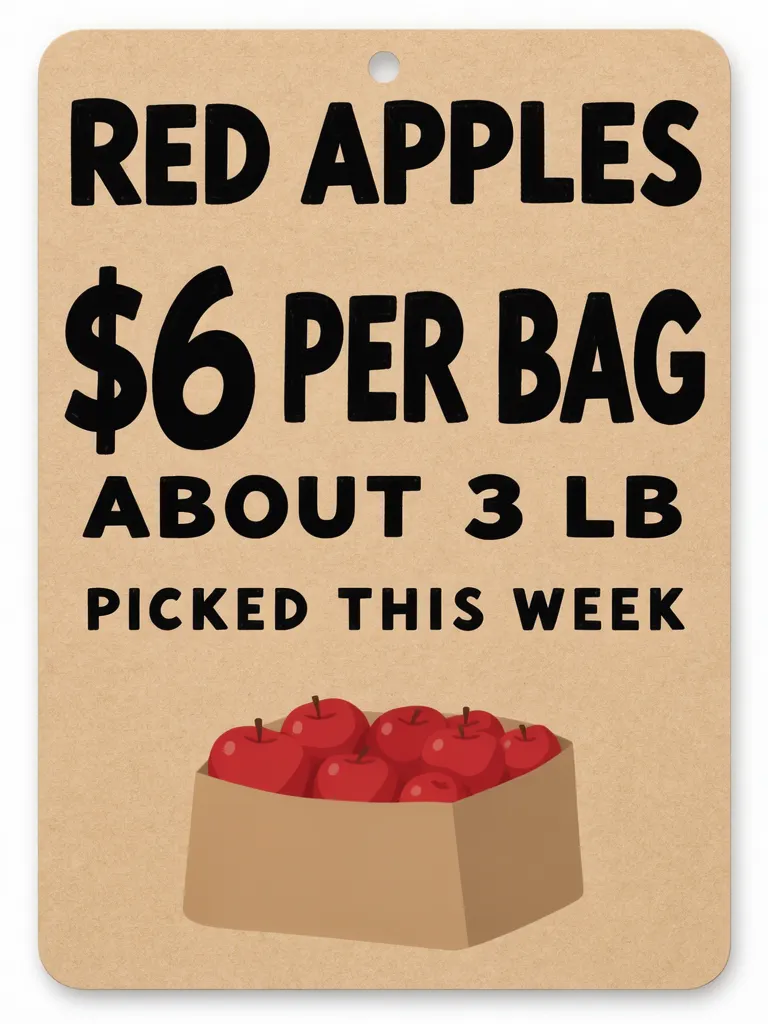
A farmers-market price tag should keep the price and its sales unit together, then place the size detail directly below or beside them. Our apple example reads “$6 PER BAG” with “ABOUT 3 LB” underneath; the tomato tag reads “$5 PER BOX” with “1 QUART BOX” below. The unit is part of the price, not decorative fine print.
TL;DR
- Put “per bag,” “per box,” or another sales unit on the same line as the amount.
- Place the bag weight or box size immediately below.
- Check every price and unit together, especially after a retry.
- Keep product names distinct from package sizes.
What should a produce price tag say?
Pair the amount with how the customer buys the produce. A number without “per bag” or “per box” leaves the shopper to guess whether it applies to one fruit, a container, a pound or a bundle. The size detail then tells them what that unit contains. Separate the product name, combined price-and-unit line, size and optional freshness note into a simple hierarchy.
The produce, prices, weights and market details in these examples are made up.
Make one like this Open this image on MOSS Image
Made in the Layout Builder with these boxes:
| Box text / object | Purpose | Approximate position |
|---|---|---|
| RED APPLES | Produce name | Top |
| $6 PER BAG | Price and sales unit | Upper middle, largest text |
| ABOUT 3 LB | Bag weight | Directly under price |
| PICKED THIS WEEK | Freshness note | Lower middle |
| Paper bag of red apples | Illustration | Bottom |
The first layout try got all four text lines right. The paper-bag drawing looks more like an open paper box, so use the actual package shape in your own drawing or skip the illustration if it could confuse shoppers. For price clarity, the key relationship is “$6 PER BAG” followed by the bag's weight.
How do you keep a price unit from disappearing?
Treat the amount and unit as one indivisible line, then check that full line in the result. The tomato photo took three generations (tries 2 to 4; try 1 was cancelled before it ran). Try 3 dropped “PER BOX,” leaving “$5” above “1 QUART BOX.” That separated the amount from its selling unit, which made the price ambiguous. Try 4 kept “$5 PER BOX” together and largest, with “1 QUART BOX” on its own line below.
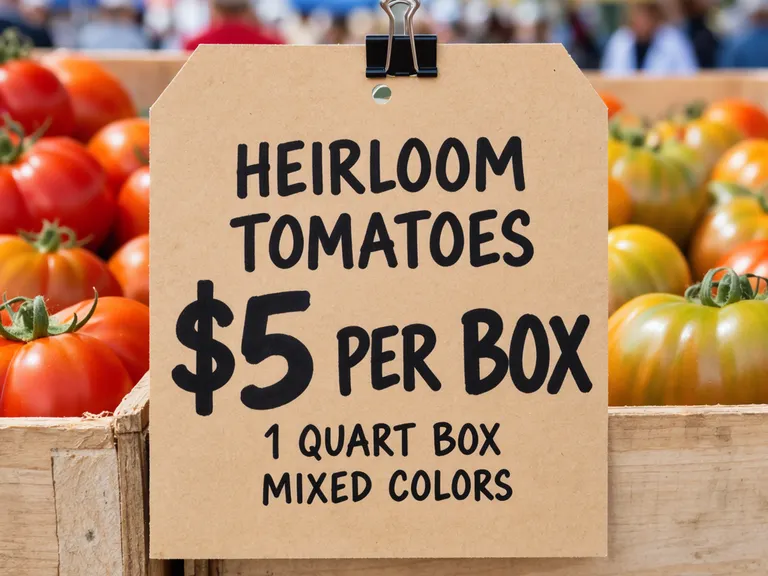
Make one like this Open this image on MOSS Image
Made in prompt mode with this exact prompt:
Close-up photograph of a kraft paper price tag clipped to a plain unmarked wooden crate of red, yellow and green heirloom tomatoes at an outdoor farmers market; the tag fills most of the frame, flat and in sharp focus, the market behind blurred to soft colour. Black hand-lettered style, the price and its unit the largest text. The crates are bare wood with no stamps, and there are no other tags or signs. The printed piece holds only the quoted text, and nothing else in view carries any writing: no other signs, labels, stickers or notes. Text, render exactly and add nothing else: headline 'HEIRLOOM TOMATOES'; largest line, price and unit together on one line '$5 PER BOX'; line '1 QUART BOX'; small line 'MIXED COLORS'.
Try 2 had invented lettering on the crates and a second garbled sign. In try 3, the tag and background were clean but the unit vanished; we combined price and unit in the same quoted line for try 4. The shared image is try 4. When reviewing a tag, read each price aloud with its unit attached: “five dollars per box,” not simply “five dollars.”
Where should size and unit information go?
Put the unit on the price line and the package size directly below it. This arrangement keeps the transaction term and the contents together without making either compete with the product name. Use the same structure across the table or stall so that shoppers can compare items by looking at the same place on each tag.
| Tag line | Apple example | Tomato example |
|---|---|---|
| Product | RED APPLES | HEIRLOOM TOMATOES |
| Price plus unit | $6 PER BAG | $5 PER BOX |
| Package detail | ABOUT 3 LB | 1 QUART BOX |
| Optional note | PICKED THIS WEEK | MIXED COLORS |
Write units that match the actual sale. If the product is priced by weight, specify the weight basis in language customers understand. If it is sold by container, say “per box” and state the container size. Do not use a size line as a substitute for the price unit: “1 quart box” explains capacity, not whether the amount applies to that box.
What should you proofread before putting tags out?
Our apple layout has the correct copy, though the bag drawing resembles an open box. The tomato photo's third try omitted “PER BOX”; the shared fourth try restored it. Proofread both text and image details before setting out the price card.
Confirm that the amount, unit, package size and product name all match the produce. Compare the printed line against the current price list, then check that the unit has not wrapped onto another line or been dropped. Zoom in on the tag itself and review any nearby crates for accidental lettering. If the price changes, replace the whole amount-and-unit line together.
How can you make a farmers-market price tag?
- Start with a 3:4 tag for a stall display or a 4:3 close-up card like the tomato example. Write the product, price plus unit, package size and optional note.
- For a designed tag, use the Layout Builder and place the full price-unit phrase in one box, with weight or capacity in a smaller box beneath it.
- For a market photo, use the AI poster generator and quote the price and unit as one complete line, such as “$5 PER BOX.”
- Inspect the number, currency symbol, unit and size as one set. The exact-text guide has more advice for checking quoted copy.
MOSS Image Studio is an independent hosted studio for the open MOSS-Image model. Not affiliated with OpenMOSS.
FAQ
Does “per bag” belong beside the price?
Yes. Put the sales unit on the same line as the price so the amount cannot be mistaken for a per-item or per-weight price.
Should I put the bag weight on the price line too?
Usually it is easier to scan when the price and sales unit share one line, with weight or capacity immediately below.
How do I make a farmers-market tag easier to compare?
Use the same order on each card: product name, amount and unit, package size, then an optional note.
Try it with your own words
Open the Studio, write a brief or lay out boxes on the canvas, and generate with MOSS-Image.