Bilingual Opening Hours Signs for a Weekly Schedule
Make a bilingual weekly hours sign with aligned day and time rows, a clear closed day, and a separate holiday notice that will not date the sign.
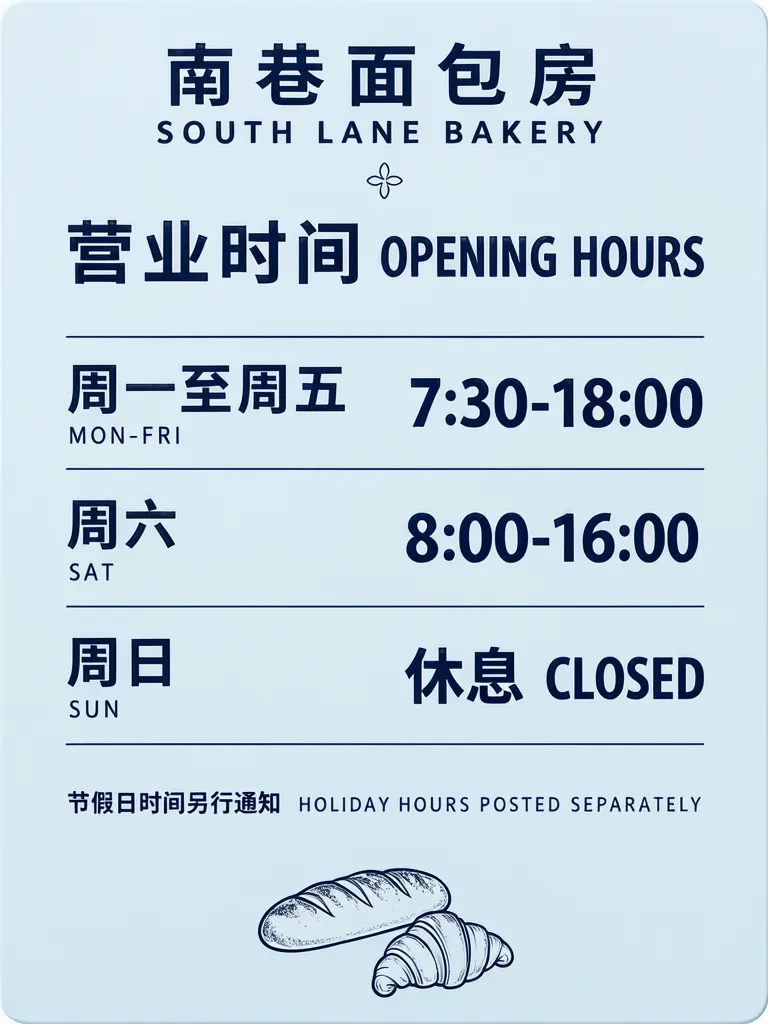
A bilingual opening-hours sign should state recurring weekly hours in a fixed pattern: weekday range, Saturday, then Sunday closed. We generated a three-row bakery sign in a structured layout and as a photo on a door; both versions kept all 13 required lines on the first try. The bakery name and hours are invented examples.
TL;DR
- Use one row for each weekly day group.
- Keep the translated day together with its hours.
- State Sunday closure explicitly.
- Put holiday changes in a separate, dated notice.
What should a weekly bilingual hours sign include?
List the recurring schedule, not a temporary exception. The example gives Monday through Friday as 7:30–18:00, Saturday as 8:00–16:00, and Sunday as closed. Each Chinese day label is paired with its English label, with the time on the same row. This makes the sign useful week after week.
Make one like this Open this image on MOSS Image
Made in the Layout Builder with these boxes:
| Box text / object | Purpose | Approximate position |
|---|---|---|
| 南巷面包房 / SOUTH LANE BAKERY | Bakery name | Top |
| 营业时间 OPENING HOURS | Sign title | Upper section |
| 周一至周五 / MON-FRI / 7:30-18:00 | Weekday row | First row |
| 周六 / SAT / 8:00-16:00 | Saturday row | Middle row |
| 周日 / SUN / 休息 CLOSED | Sunday row | Lower row |
| 节假日时间另行通知 HOLIDAY HOURS POSTED SEPARATELY | Holiday notice | Bottom |
| Loaf and croissant | Illustration | Bottom area |
All 13 lines were correct first try. The layout added a small flower ornament beneath the bakery name. It is decorative and does not change the schedule; if a plain sign matters to your storefront, ask for no ornament.
Why say holiday hours are posted separately?
A weekly sign should remain valid after a particular holiday passes. The line “节假日时间另行通知 HOLIDAY HOURS POSTED SEPARATELY” tells visitors that an exception will be communicated elsewhere, instead of embedding dates that soon expire. For a one-off change, a dated notice is clearer; see our Black Friday hours example.
Make one like this Open this image on MOSS Image
Made in prompt mode with this exact prompt:
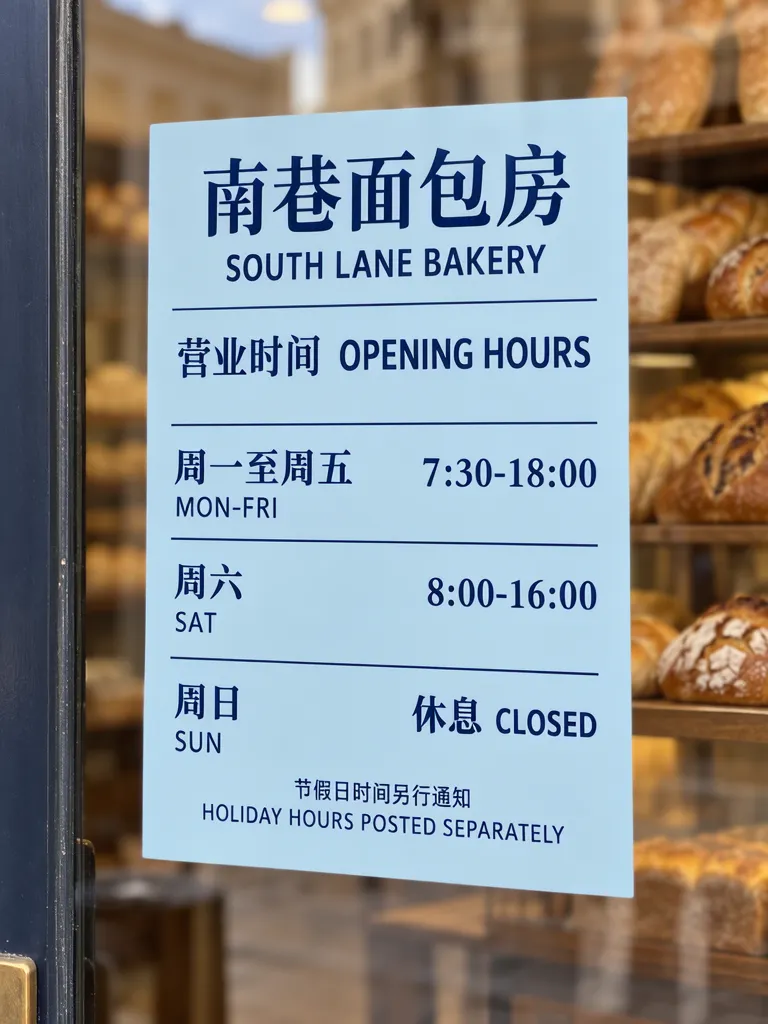
Photograph of a printed opening hours sign hanging inside the glass door of a small bakery, seen from the street, shelves of bread softly blurred behind, the sign flat and in sharp focus. Pale blue card, navy type, three rows separated by thin rules, the Chinese day with the English day directly underneath on the left and the hours on the right. No other paper or sticker on the door. The printed piece holds only the quoted text, and nothing else in view carries any writing: no other signs, labels, stickers or notes. Text, render exactly and add nothing else: top line '南巷面包房'; line 'SOUTH LANE BAKERY'; title '营业时间 OPENING HOURS'; row '周一至周五'; under it 'MON-FRI'; hours '7:30-18:00'; row '周六'; under it 'SAT'; hours '8:00-16:00'; row '周日'; under it 'SUN'; hours '休息 CLOSED'; note '节假日时间另行通知 HOLIDAY HOURS POSTED SEPARATELY'.
The photo version also kept all 13 lines on the first try and left the door free of other paper. The holiday note breaks into separate Chinese and English lines, which keeps the message readable without adding holiday dates to the recurring schedule.
How should you format the day and time rows?
Use the same order for every row: Chinese day, English day, hours. Make the time visually distinct but keep it level with its day pair. A three-row layout is easy to update because a changed Saturday schedule does not require rewriting the weekday line.
| Row | Chinese | English | Hours |
|---|---|---|---|
| Weekdays | 周一至周五 | MON-FRI | 7:30-18:00 |
| Saturday | 周六 | SAT | 8:00-16:00 |
| Sunday | 周日 | SUN | 休息 CLOSED |
What should you check before displaying it?
Verify the opening and closing times against the business's current schedule, including which days count as weekdays. Confirm that “closed” is unmistakable in both language versions and that the English abbreviations match the intended days. Read the sign from the entrance or window where it will be posted, then make sure smaller holiday wording remains legible. If hours change for a specific date, replace or supplement the weekly sign with a notice that includes the date and affected hours.
How do you make a bilingual opening-hours sign?
- Write the week pattern first: weekday range, Saturday, Sunday, with a Chinese and English label for each.
- In the Layout Builder, create three aligned row boxes and a separate holiday note. For a door scene, use the AI poster generator.
- Keep holiday dates out of the reusable weekly sign; make a separate dated version when hours change once.
- Check every day label and time, then read it at the place it will be posted. The exact-text guide covers reviewing generated copy.
MOSS Image Studio is an independent hosted studio for the open MOSS-Image model. Not affiliated with OpenMOSS.
FAQ
Should a weekly sign list public holidays?
Keep the recurring schedule on the weekly sign. Post holiday hours separately with the dates, so the regular sign does not become outdated.
How do I show a closed day in two languages?
Put the day labels together and use an explicit pair such as “休息 CLOSED” in that row.
Should opening hours use AM and PM?
Use the time format customers in your area expect, and keep that format consistent across every row.
Try it with your own words
Open the Studio, write a brief or lay out boxes on the canvas, and generate with MOSS-Image.