How to design winter solstice dumpling menus for 2026
Arrange a winter solstice dumpling menu with clear flavour-price rows, Chinese translations, chalk-preset examples and practical portion checks.
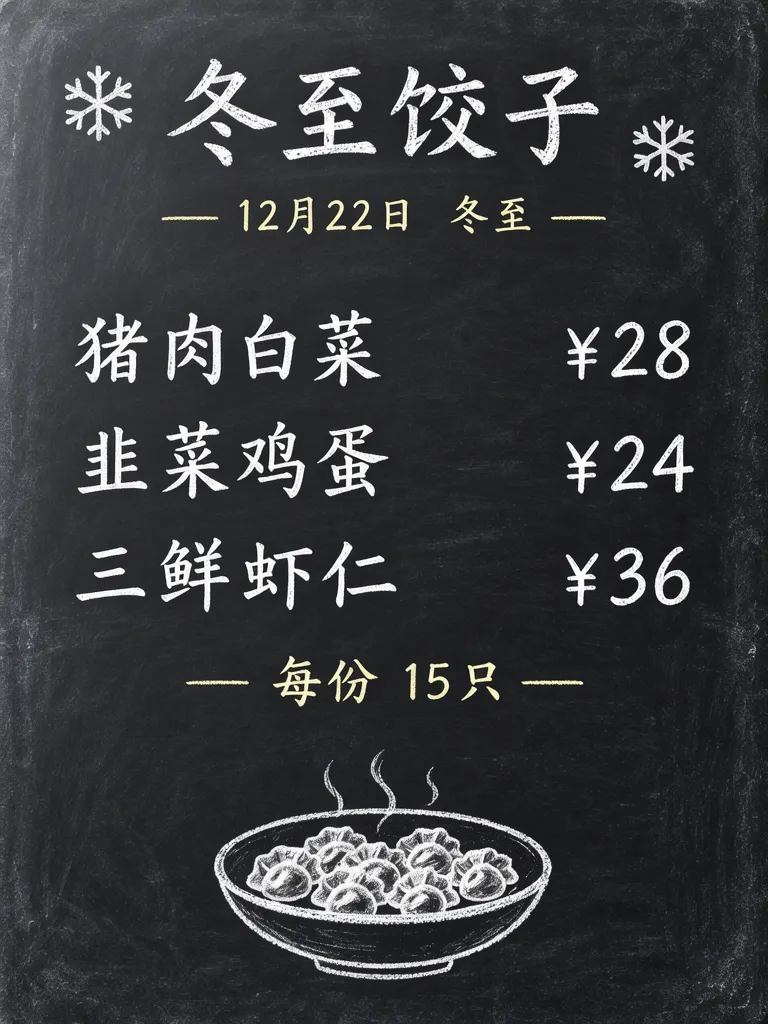
Winter solstice dumpling menus for 2026 should keep each filling and its price on one readable row, with the portion size stated separately. These examples use the China-local solstice date, Tuesday, December 22, and three Chinese menu items on a chalkboard. For an overseas restaurant or community meal, retain that date only when it matches the occasion you intend to advertise.
TL;DR
- Give each filling-price pair a row of its own.
- Keep the portion note readable rather than treating it as decoration.
- Choose the
chalkpreset when you want a chalkboard appearance. - Confirm the currency and amounts for your local menu.
What does the Chinese menu actually say?
It offers three example fillings under “冬至饺子,” meaning “winter solstice dumplings.” The date line says “December 22, winter solstice,” and the portion note says “15 dumplings per serving.”
| Chinese row | English reading | Sample price |
|---|---|---|
| 猪肉白菜 | Pork and napa cabbage | ¥28 |
| 韭菜鸡蛋 | Chinese chives and egg | ¥24 |
| 三鲜虾仁 | Shrimp “three-delicacies” filling | ¥36 |
“Three delicacies” is a menu name here, not a complete ingredient declaration. The image does not identify every ingredient in that filling. For an overseas audience, ask the kitchen for the actual recipe before writing a fuller English description. These China-local examples use yuan; replace both the currency notation and amounts for your own menu.
How does the layout keep each price with its filling?
It gives each complete flavour-price pair its own horizontal box, below the heading and date. The portion note follows the rows, with the dumpling illustration at the bottom.
The shop, its fillings and its prices are made up for these examples.
Make one like this Open this image on MOSS Image
Made in the Layout Builder with the chalk style preset and these boxes:
| Box text / object | Job | Approximate position |
|---|---|---|
| 冬至饺子 | Menu heading | Top |
| 12月22日 冬至 | Occasion date | Below heading |
| 猪肉白菜 ¥28 | Pork row | Upper middle |
| 韭菜鸡蛋 ¥24 | Chive row | Middle |
| 三鲜虾仁 ¥36 | Shrimp row | Below middle |
| 每份 15 只 | Portion count | Below rows |
| (illustration) | Dumpling drawing | Bottom |
Our first try got the required text right, with each flavour and price on its own row and the prices right-aligned. This is the useful result to copy as a structure: a reader can follow a filling across to its price without switching to another line.
When adapting it, write each row as one approved string before generating. Keep the item order fixed while checking the prices. If you change a filling name, recheck the amount on that same row rather than assuming the number beside it still belongs there.
What changes in the dumpling-shop scene?
The text stays correct, but the portion note becomes small and left-aligned rather than centred. Give that note a larger text area if you need it to stand out in your version.
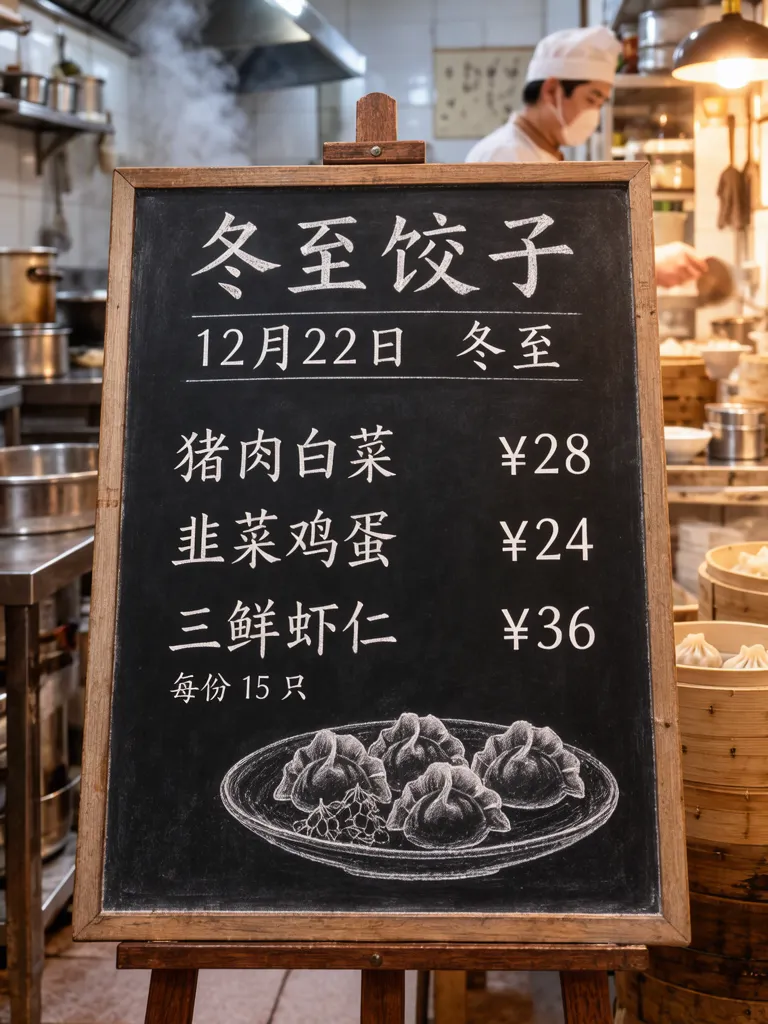
Make one like this Open this image on MOSS Image
Made in prompt mode with the chalk style preset and this exact prompt:
Photograph of a chalkboard menu propped on an easel inside a small dumpling shop, warm light, steam from a kitchen behind, board in sharp focus. Three menu rows with the flavour on the left and the price on the right, small dumpling drawing at the bottom. Text, render exactly and add nothing else: heading '冬至饺子'; line '12月22日 冬至'; rows '猪肉白菜 ¥28', '韭菜鸡蛋 ¥24', '三鲜虾仁 ¥36'; note '每份 15 只'.
The small portion note matters because it says what the price buys. In your own version, give that note enough room to be read at the display size. Write the serving count explicitly beside the menu rows.
How should an overseas restaurant adapt this example?
Keep the row structure, but confirm the local offer independently. December 22 is the solstice date in China time; in other time zones the date can differ, so check a local calendar. If you are hosting a December 22 meal, present that as your event date.
For a bilingual menu, choose short English filling names confirmed by the kitchen and give them room beneath the Chinese. Preserve one clear price per item. Put separately confirmed ingredient information where customers can access it, and keep the poster focused on the items and amounts it can show clearly.
What still needs checking before this becomes a printed menu?
The text was correct in both first attempts, but the shop version's portion note was small and shifted left. Chalk styling does not remove the need to inspect digits, currency signs and Chinese characters. In particular, compare ¥28, ¥24 and ¥36 against the same rows in the source copy.
Print a proof at the intended size and read across each row with a finger. Then read “每份15只” on its own. If the note is hard to see, increase its box or simplify the lower illustration and generate again. Confirm servings, recipe details and prices with the person responsible for the menu.
How can you build a three-row dumpling menu?
- Choose 3:4 portrait and the
chalkpreset, as we did for both menus. The preset adds a style phrase to the scene; prepare the menu wording before choosing the surrounding illustration. - In the Layout Builder, draw the heading and date above three horizontal rows. Put one complete filling-price pair in each row, request right-aligned prices and give “每份15只” its own box below.
- For a shop scene, use the AI poster generator with the same ratio and preset. Quote each menu line separately and use the exact-text guide to keep kitchen details outside the menu copy.
- Check each price beside its filling first, then read the portion note at the intended display size. For a bilingual version, allow a short English filling name beneath each Chinese name while keeping one price attached to the pair.
MOSS Image Studio is an independent hosted studio for the open MOSS-Image model. Not affiliated with OpenMOSS.
FAQ
Does “每份15只” mean fifteen dumplings in total for all flavours?
It means fifteen per serving in this example. It does not state a mixed-flavour arrangement. If your shop sells a mixed portion, write that rule explicitly rather than asking the illustration to explain it.
Can I keep the yuan prices for an overseas event?
Only if they are genuinely the prices and currency you intend to charge. Otherwise replace both the amounts and currency notation with confirmed local information.
What should a bilingual dumpling menu translate?
Translate the filling names and portion note, keeping each translation beside its Chinese line. Confirm ingredients with the kitchen before expanding a short dish name into a description.
Sources
- China-local December solstice date and weekday — Checked on 2026-11-03.
Try it with your own words
Open the Studio, write a brief or lay out boxes on the canvas, and generate with MOSS-Image.